Do Letters Look Like They Sound?
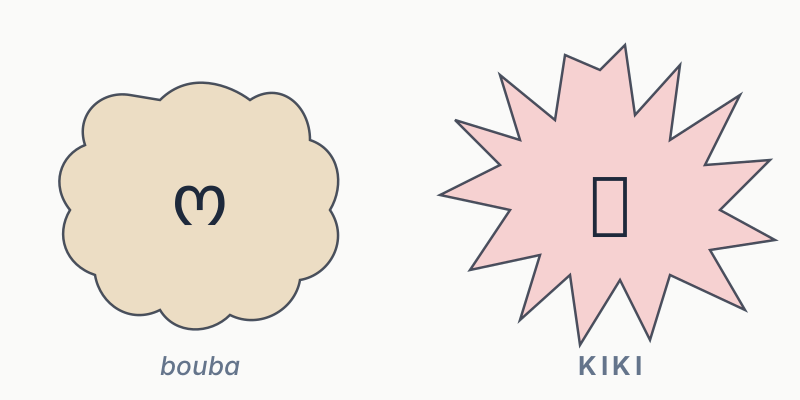
Say “bouba.” Now say “kiki.” Which one sounds round and which one sounds spiky? You probably already know — and so does pretty much everyone else, no matter what language they speak. This is the bouba/kiki effect, and my good friend Alexander Porto has been investigating whether it shows up in the actual shapes of real writing systems.
I helped out on the statistics and data side — Alexander did the heavy lifting on theory, experiments, and the massive glyph database. Alexander Basalyga, Julio Santiago, Elizabeth Fein, and Alexander Kranjec rounded out the team. It turned into two papers, with a third on the way.
The short version
Paper 1 (CogSci 2024): Can people match isolated speech sounds to unfamiliar characters from writing systems they’ve never seen? Yes. Participants from 5 continents heard single vowels and consonants, then picked between a round and an angular glyph. Vowels increased the odds of choosing a round glyph by 30% — across all languages and backgrounds tested.
Paper 2 (Behavior Research Methods, 2025): The methods backbone. Alexander built a normed database of 3,208 glyphs from dozens of scripts and developed computational measures of angularity. The best one — first-order entropy of edge orientations — correlates at r = −0.84 with human judgments. You can now score any character’s angularity without running a human study. Everything is open-access on OSF.
So what?
The standard view is that writing is arbitrary — “A” doesn’t look like /a/ for any deep reason. These results suggest that’s not entirely true. Across thousands of characters from scripts spanning the globe, round sounds tend to be written with rounder shapes. It’s subtle, but it’s consistent, and it’s cross-cultural. Whether that tells us something about how writing systems evolved or how the brain links vision and hearing is still open.
It was a fun project to be part of, and I’m glad Alexander pulled me in. A third paper extending this work is nearly finished — more on that soon.
References
Porto, A., Huckle, N., Basalyga, A., Santiago, J., & Kranjec, A. (2025). Glyph norming: Human and Computational Measurements of Shape Angularity in Writing Systems. Behavior Research Methods, 57, 173. doi:10.3758/s13428-025-02682-7
Porto, A., Basalyga, A., Huckle, N., Santiago, J., Fein, E., & Kranjec, A. (2024). Sound symbolism across diverse writing systems. Proceedings of the Annual Meeting of the Cognitive Science Society, 46. eScholarship