The City That Rains on Me
Based on DWD Climate Data Center data.
I moved to Frankfurt in 2023. Before that: six years in Leipzig. Within weeks of arriving I was convinced this city was absurdly, unreasonably wet. I started telling people Frankfurt was one of the rainiest cities in Germany.
I was wrong.
Ranking all cities in Germany
Daily precipitation data from the DWD for 34 German cities, 1991–2024. Metric: days per year with at least 1 mm of rain.
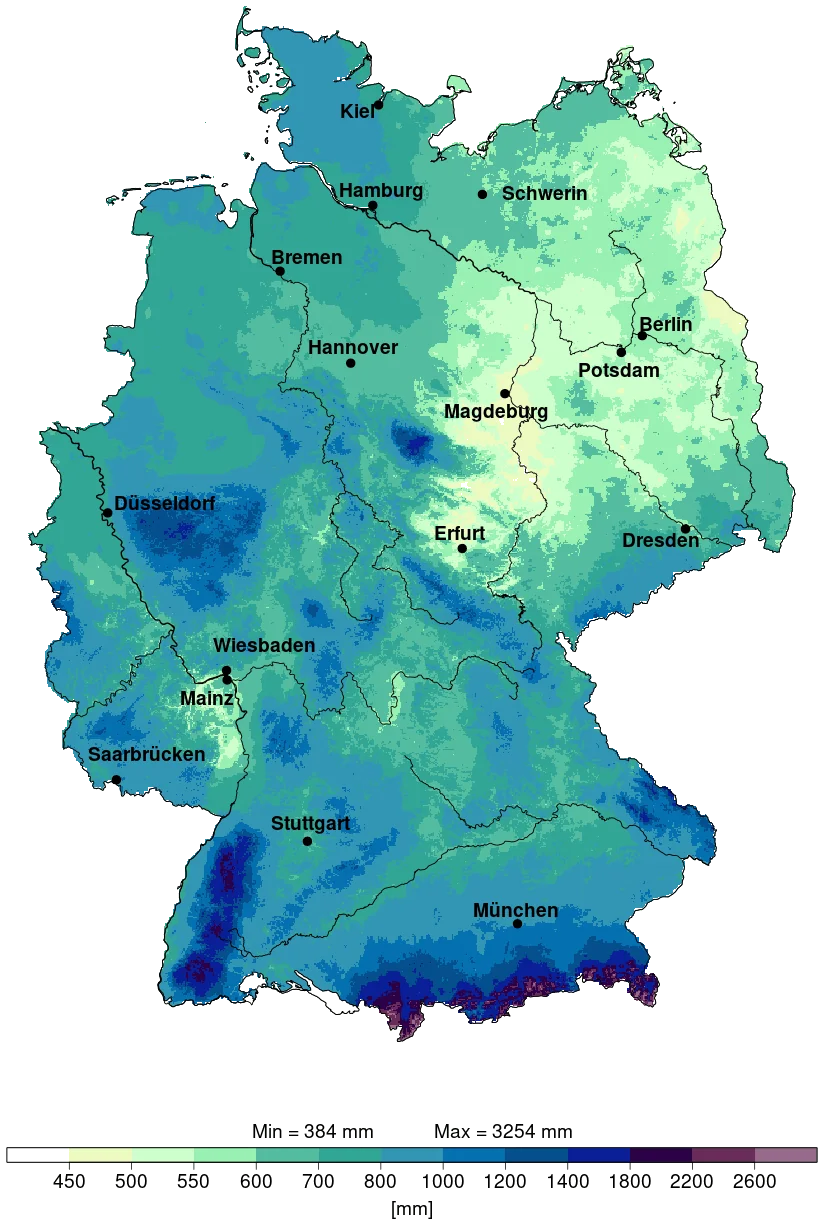
Frankfurt sits at 110.7 rain days per year — rank 25 out of 34, firmly in the bottom third. The real rain divide in Germany isn’t north vs. south, it’s west vs. east. Atlantic weather systems push moisture inland through the Rhine corridor, drenching the Rhineland and the North Sea coast. The eastern lowlands — Halle, Erfurt, Magdeburg — sit in their rain shadow and are borderline dry by German standards. Leipzig, where I lived before Frankfurt, averages just 101 rain days per year. Frankfurt is stuck in the middle of this gradient, wetter than the east but nowhere near the Rhine’s rain belt.
My bad timing
I didn’t arrive in an average year.
The long-term average is 109.7 rain days (1991–2022). The gold line shows Leipzig’s average rain days during my years there (2016–2022) — a comparatively dry stretch — the blue bars are my Frankfurt years. My first year there (2023): 129 days — 94th percentile. My second (2024): 123 days — 91st percentile. Both were among the wettest since records began at the Westend station in 1985. 2025 settled back to a normal 92 days, but through early March 2026 the pace is climbing again.
I didn’t move to a rainy city. I moved to a city during a rainy stretch.
Does it rain more during the day?
Another theory: maybe Frankfurt rains more while you’re awake. Rain at 3am doesn’t ruin your commute. The same total rain count would feel like much more if it were biased toward waking hours.
To test this I pulled hourly precipitation records from the DWD for 33 German cities. The key metric: what share of all rain-hours falls between 07:00 and 19:00?
All 33 cities land within a 4-percentage-point band (47–52%). Rain is essentially evenly split between day and night, everywhere in Germany. Frankfurt (50.6%) is exactly mid-table. The southern cities — München, Augsburg, Freiburg — sit below 48%, likely reflecting Alpine convection patterns.
The “My time” markers show my personal years in each city: both land squarely inside the national noise band. Frankfurt was not ambushing me with daytime rain.
Same rain, more heat in Frankfurt
Frankfurt and Leipzig get rained on equally hard — about 5.9 and 5.6 mm per rain day. But Frankfurt is 1.3°C warmer on average. Same rain, more muggy heat. When it rains here it tends to be after a sweaty buildup — thunderstorms that feel subtropical even when the numbers say “average.”
The actual reason
The data rules out two intuitive explanations: Frankfurt isn’t rainier than average, and it doesn’t rain at worse times of day. What actually explains the perception gap?
Bad timing, mainly. Two back-to-back 90th-percentile years set the bar, and Leipzig during dry years set the baseline.
But also: I stopped taking transit. In Leipzig I lived 30 seconds from a tram stop and a cityflitzer carsharing spot. Door to door, I was barely exposed to the sky. In Frankfurt I live centrally but far from any useful transit line — so most trips happen by e-bike. That means I’m outside, in the weather, every single time. Same sky, much more skin in the game.
Data · DWD Climate Data Center, daily KL records for 34 German cities, 1991–2024. Frankfurt station: Frankfurt/Main-Westend (01424). Hourly analysis: 33 stations (all ranking cities except Bonn), various periods from 1996–2024. Frankfurt hourly: 2009–2024. 2026 figures are partial-year projections based on data through early March.
Inspiration · Datawrapper’s sunshine in Berlin vs. Europe.