Optimal Public Holidays in Germany
Motivation
Comparing the public holidays of different German states — why does Augsburg have so many? — or entire countries is common practice. These days not only reduce the annual workload but also offer opportunities for bridge-day mini-holidays.
The interesting — or problematic, as we’ll see — factor is the fixed-date holidays. These holidays fall on the same date each year but on a varying weekday, which means they can land on weekends. The number of actual days off therefore changes from year to year, and 2021 was a particularly bad draw. That’s what this post is about.
The Culprits
In Saxony we have the following six fixed-date holidays:
- 01.01. New Year’s Day
- 01.05. Labour Day
- 03.10. German Unity Day
- 31.10. Reformation Day
- & 26.12. Christmas
The moveable holidays (Easter, etc.) don’t concern us here since they’re equally good (or bad, like Buss- und Bettag) every year.
2021 — A Disaster
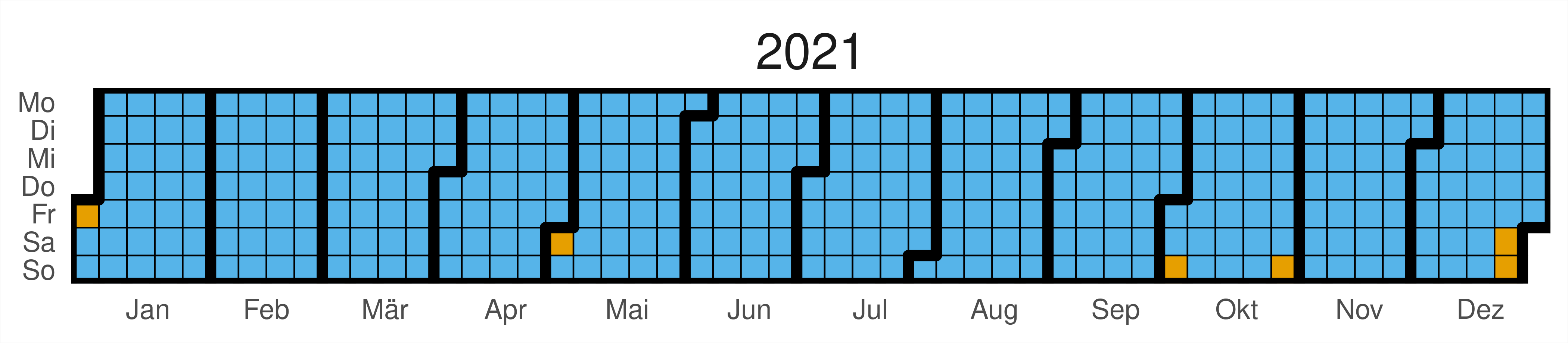
2021 started well enough — 1 January fell on a Friday, giving us a long New Year’s weekend. But that was it. Not a single bridge day. All five remaining fixed holidays fell on weekends.
No worse configuration is possible for Saxony, and it repeats: the last such year was 2010, the next will be 2027 and 2038.
2014/2025 — Peak Holiday
The best configuration occurs in 1997, 2003, 2014, 2025, and 2031:
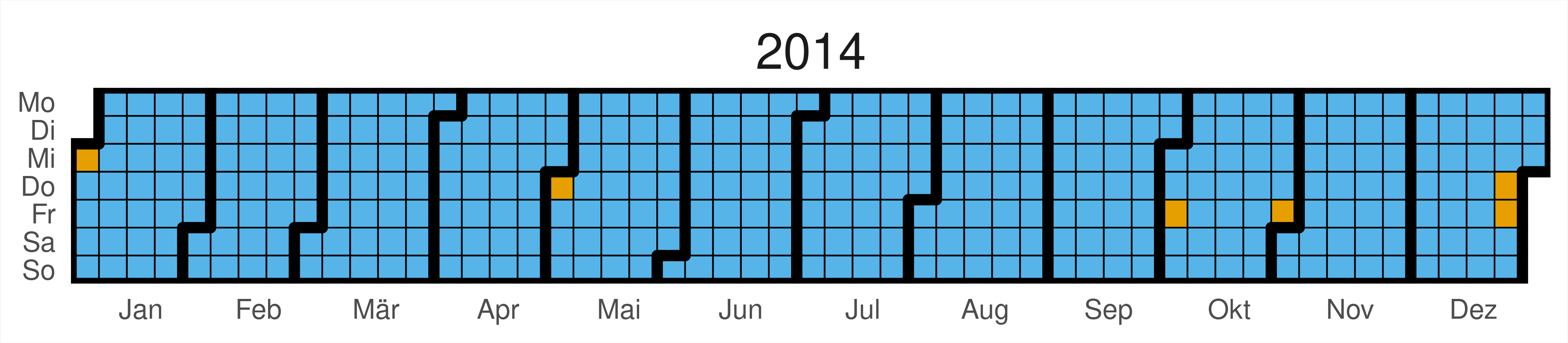
Here, 1 January falls on a Wednesday — not ideal in isolation, but by year’s end most people will have two leftover holiday days to create a five-day New Year’s break. Labour Day lands on a Thursday, enabling another bridge-day weekend. The last four holidays all sit perfectly next to the weekend. No holiday days needed — you simply get two three-day weekends followed by four consecutive days off to close the year.
Bottom Line
The difference between worst and best case is a full 5 working days — in 2021 employees worked 255 days, in 2014 only 250. Most other years fall somewhere in between, leaning closer to the favourable end. In 2021, we were genuinely stuck with the worst possible outcome.
A detailed overview of these repeating patterns is available on Wikipedia.